
Professional RFID Keyfob Manufacturer
Offering RFID Keyfob At Good Price
- Full range of chips with low frequency, high frequency and ultra-high frequency
- There are ABS, wood, leather, silicone and other materials to choose
- Quality warranted, all products in our factory are covered by a one year warranty
- No middleman, support customized products
- ID/IC keychains in stock and fast shipping
- Professional service, higher cost performance and better experience
RFID Key Fob Definition
RFID Key Fobs are RFID tags designed to take the shape of key fobs. They have a microchip and an antenna. The chip stores data, while the antenna receives and transmits radio waves that aid in data exchange.
The RFID key fob can hold low frequency, high frequency, or ultra-high frequency tags.When choosing your ideal RFID key fob, you should ensure that you only pick the right frequency for the best results.
RFID key fobs are used in many places, such as control, attendance control, identification, logistics, industrial automation, ticketing, casino tokens, membership, public transportation, electronic payment, swimming pools, and laundries.

RFID Keyfob by Material
ABS RFID Keyfob
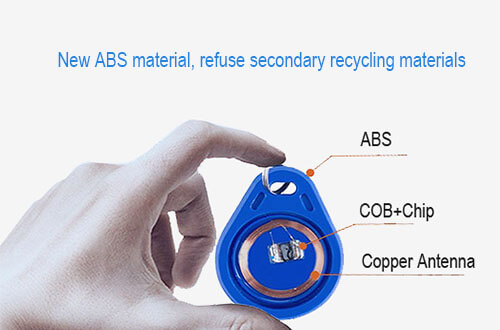
An ABS RFID key fob is made of an ABS shell, a chip, and an antenna. It is used in many RFID management applications, such as access control and identification systems.
ABS RFID key fobs are available upon request in the most common 125 kHz, 13.56 MHz, and 916 MHz RFID chip types. The chip code can be laser engraved or painted on one side, which saves time when checking the ID code of each key fob holder. This greatly improves management efficiency.
PU Leather RFID KeyFob
A PU Leather RFID Key Fob is made of a leather case that holds RFID cards. It is used a lot in RFID management applications, such as access control and identification systems.
The PU Leather RFID Key Fob is high-end and is available in the most common RFID chip types (125 kHz, 13.56 MHz, and 915 MHz) upon request.

RFID Wooden Keyfob
Our RFID wood keychain is made of natural wood. It is eco-friendly, which makes it special and unique.
Our wooden sensor keychain can also be as colorful as a PVC keychain. We offer silk screen printing, laser engraving, and CMYK full color. You can customize the style of our wooden keychain in various sizes.

RFID Silicone Keyfob
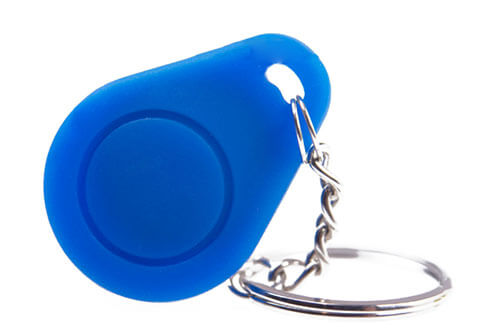
The RFID Silicone Keyfob combines RFID technology with a silicone case that is both attractive and practical. They can be easily mounted on a key ring. They can be customized to customer requirements, and color logos can be added. Serial numbers can also be printed for easy identification.
The RFID Silicone Keyfob is available upon request in the most common 125 kHz, 13.56 MHz, 915 MHz RFID chip types. These key tags are the best solution for security systems, access control systems, and time and attendance systems.
Epoxy RFID Keyfob
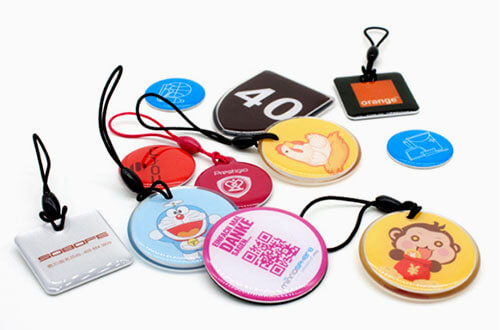
The epoxy RFID keychain is covered with epoxy resin on both sides of the PVC card. The beautiful design is sure to catch customers’ eyes, and the company’s image is promoted by the attractive appearance.
The epoxy RFID keyfob is available upon request in the most common 125 kHz, 13.56 MHz, and 915 MHz RFID chip types. It is widely used in access control, pet management, etc.
Metal wrapped RFID keychain
The metal-covered RFID key fob is wrapped in metal around the epoxy RFID perimeter, making it stronger and more durable.
The metal-covered RFID key fob is available in the most common 125 kHz, 13.56 MHz, and 915 MHz RFID chip types upon request. It is widely used in access control and pet management, among other things.

RFID Keyfob by Frequency

125KHz RFID Keyfobs
The 125 kHz RFID low-frequency key fob has minimal interference with metal and can be customized with a logo and serial code. It is mainly used for access control and automatic identification.

13.56MHz RFID Keyfobs
The 13.56 MHz RFID Keyfob is perfect for access control, event management, and tracking keys. It’s waterproof, the keyfob tag responds reliably in low or high temperatures, and it’s NFC-compatible.

UHF RFID Keyfobs
RFID UHF key fobs can be customized with logos, serial codes, or EPC laser-etching. They are used for two things: access control and automatic identification.
Our RFID Keyfobs Product List
How to Choose the Right RFID Keyfob
1. Make sure you have your own system
RFID tags can’t be used on their own. You need to have your own system or be a system integrator so you can buy your own RFID tags.
2. Tell us the type of chip you are using
The chip is the most important part of the RFID system. It stores and exchanges data. The first step in designing the system is choosing a good chip model. Different chip models have different features and prices. You need to determine which model is right for your system.
If you don’t know your chip model, you can send us a sample of your hand to help us test the model.
3. Select RFID Stickers material and size
The price depends on the material and size. Choose the material and size that works best for your budget.
4. Define your additional processes
We can customize the logo, print UID, encoding data, etc. for RFID Keyfob.
Getting Your RFID Keyfob
Our professional technical team is here to help. We invite you to compare our prices and services.
- All information is kept secret and safe.
Application of RFID Keyfob

Access Control
The main purpose of RFID key fobs is to control access. Their microchips are programmed with a unique identifier that can be read by an RFID reader.
When the RFID reader scans the tag, it compares the identifier with a list of authorized users. If the user is on the list, they will be granted access. If not, they will be denied access.

Pet Management
RFID key fobs can also be used to manage pets. The key fob can have a chip put inside it that has a product code.
When the reader scans the chip, the code is captured and sent to an RFID software system. This information is then used to track and identify pets.

Event Management
RFID key fobs can be used to manage events. Their unique identifiers can be used to track how many guests attend an event and for event payment.
This information can be used to plan future events or to evaluate the success of past events.
Frequent Asked Questions
What are RFID key fobs?
A key fob contains a radio transmitter/radio frequency identification (RFID) chip and antenna. It uses radio frequencies to send a unique coded signal to a receiver unit in the device. This receiver also contains an RFID tag, which stores information.
Are key fobs RFID or NFC?
The RFID key fob uses RFID technology, which is a type of NFC.
Can RFID fob be copied?
The RFID Keyfob can be copied or not, depending on the specific chip type and encryption method. The read-only TK4100 chip is the most easily copied. The encryption method of the high-frequency M1 chip is also easy to copy if it is simple.
Can I use my iPhone as a RFID card?
It depends on whether the chip on your card is RFID or NFC. If it’s NFC, it can use your phone as an RFID card.
What is the range of a RFID key fob?
RFID keyfob usually small size, low frequency and high frequency reading distance is generally in 0-5cm, more than the frequency of the reading distance in 0-2m.
How does RFID work without power?
The passive RFID keyfob itself has no power. It is powered by the RF energy transmitted by the RFID reader/antenna. The signals sent by the reader and antenna are used to power the RFID Keyfob. They also reflect the energy back to the reader.
Can RFID be hacked?
Some chips can be rewritten, which means hackers can delete or replace RFID information with their own data. However, most chips are highly encrypted and cannot be replicated by hackers.
Can you be tracked with RFID?
The RFID Keyfob can be attached to a lanyard, Velcro, or other attachment so that the person being tracked can easily carry it. Once the person has the tag, it can be tracked through a facility, field, tool yard, or wherever is needed.
Do car keys use RFID?
Since 1995, almost all cars have had an RFID transponder. This is a small device that sends and receives signals. It is located in the plastic housing around the key grip. These 13.56 MHz transponders communicate with an RFID reader. The reader is located in the steering column.
What can block a key fob signal?
Metal and water cause the most radio frequency interference. You can put the RFID Keyfob in a metal box. There are many shielded wallets online. There is a layer of metal fabric inside the shielded card sleeve.
Common RFID chips
| IC | Memory | Protocol | Read/Write | Datasheet |
|---|---|---|---|---|
| TK4100 | 64bit | ISO7815 | Read-only | Download |
| EM4200 | 128bit | ISO7815 | Read-only | Download |
| EM4305 | 512bit | ISO11784/11785 | Read&Write | Download |
| EM4450 | 1kbit | ISO11784/11785 | Read&Write | Download |
| ATA5577 | 224bit | ISO11784/11785 | Read&Write | Download |
| Hitag 1 | 2048bit | ISO11784/11785 | Read&Write | Download |
| Hitag2 | 256bit | ISO11784/11785 | Read&Write | Download |
| MIFARE Classic 1k(S50) | 1K Bytes | ISO14443A | Read&Write | Download |
| MIFARE Classic 4k(S70) | 4K Bytes | ISO14443A | Read&Write | Download |
| MIFARE Ultralight EV 1 | 512bit | ISO14443A | Read&Write | Download |
| MIFARE Ultralight C | 192 Bytes | ISO14443A | Read&Write | Download |
| MIFARE Plus EV2(2K) | 2K Byte | ISO14443A | Read&Write | Download |
| MIFARE Plus EV2(4K) | 4K Bytes | ISO14443A | Read&Write | Download |
| MIFARE Plus SE(2K) | 2K Byte | ISO14443A | Read&Write | Download |
| MIFARE Plus SE(4K) | 4K Byte | ISO14443A | Read&Write | Download |
| MIFARE Plus X(2K) | 2K Byte | ISO14443A | Read&Write | Download |
| MIFARE Plus X(4K) | 4K Byte | ISO14443A | Read&Write | Download |
| MIFARE Desfire Light | 640 Bytes | ISO14443A | Read&Write | Download |
| MIFARE Desfire EV3(2K) | 2K Bytes | ISO14443A | Read&Write | Download |
| MIFARE Desfire EV3(4K) | 4K Bytes | ISO14443A | Read&Write | Download |
| MIFARE Desfire EV3(8K) | 8K Bytes | ISO14443A | Read&Write | Download |
| NTAG 213 | 144 Bytes | ISO14443A | Read&Write | Download |
| NTAG 215 | 504 Bytes | ISO14443A | Read&Write | Download |
| NTAG 216 | 888 Bytes | ISO14443A | Read&Write | Download |
| NTAG 213 Tag Temper | 144 Bytes | ISO14443A | Read&Write | Download |
| NTAG 424 DNA | 416 Bytes | ISO14443A | Read&Write | Download |
| NTAG 424 DNA Tag Tamper | 416 Bytes | ISO14443A | Read&Write | Download |
| ICODE SLIX | 896 bits | ISO15693/ISO 18000-3M1 | Read&Write | Download |
| ICODE SLIX 2 | 2528 bits | ISO15693/ISO 18000-3M1 | Read&Write | Download |
| ICODE SLIX-L | 256 bits | ISO15693/ISO 18000-3M1 | Read&Write | Download |
| ICODE SLIX-S | 1280 bits | ISO15693/ISO 18000-3M1 | Read&Write | Download |
| ICODE DNA | 2016 bits | ISO15693/ISO 18000-3M1 | Read&Write | Download |
| Tag-It™ HF-I Standard (TI 256) | 256 Byte | ISO15693 | Read&Write | Download |
| Tag-It™ HF-I Plus (TI 2048) | 2K Bytes | ISO15693 | Read&Write | Download |
| Higgs 3 | 96 bit epc,512 bit user | EPC Class1 Gen2/ISO 18000 6C | Read&Write | Download |
| Higgs 4 | 128 bit epc,512 bit user | EPC Class1 Gen2/ISO 18000 6C | Read&Write | Download |
| MONZA 4QT | 128 bit epc,512 bit user | EPC Class1 Gen2/ISO 18000 6C | Read&Write | Download |
| Monza 5 | 128 bit epc,32 bit user | EPC Class1 Gen2/ISO 18000 6C | Read&Write | Download |
| Monza R6 | 96bit epc | EPC Class1 Gen2/ISO 18000 6C | Read&Write | Download |
| Monza R6-P | 96bit epc,32 bit user | EPC Class1 Gen2/ISO 18000 6C | Read&Write | Download |
| UCODE 7 | 128 bit epc | EPC Class1 Gen2/ISO 18000 6C | Read&Write | Download |
| UCODE 7m | 128 bit epc | EPC Class1 Gen2/ISO 18000 6C | Read&Write | Download |
| Ucode 8 | 128 bit epc | EPC Class1 Gen2/ISO 18000 6C | Read&Write | Download |
| Ucode 8m | 96 bit epc,32 bit user | EPC Class1 Gen2/ISO 18000 6C | Read&Write | Download |
| UCODE DNA | 224bit epc,3072 bit user | EPC Class1 Gen2/ISO 18000 6C | Read&Write | Download |