
Professional RFID Stickers Manufacturer
Offering RFID Stickers At Good Price
- Full range of chips with low frequency, high frequency and ultra-high frequency
- There are ABS, wood, leather, silicone and other materials to choose
- Quality warranted, all products in our factory are covered by a one year warranty
- No middleman, support customized products
- Professional service, higher cost performance and better experience
RFID Stickers Definition
RFID stickers are small tags that can be attached to things for tracking. They have an antenna, a small computer chip, and a thin sticky part. The computer chip has enough memory to store information about a particular item. Once the sticker is attached to the item, it will allow tracking and easy identification.
RFID stickers can be printed using a special RFID printer. They are common in car tracking and identification.

Our RFID Stickers Product List
RFID Stickers by Material
Paper RFID Stickers
Paper RFID labels are the most commonly used RFID stickers. They are used a lot because they are relatively inexpensive and easy to print.
Paper RFID labels are used for asset management, inventory management, and more.

PET RFID Stickers
A PET RFID label is better for the environment, lasts longer, and is more durable than a paper RFID label. It also supports proofing.

Fragile RFID Tags
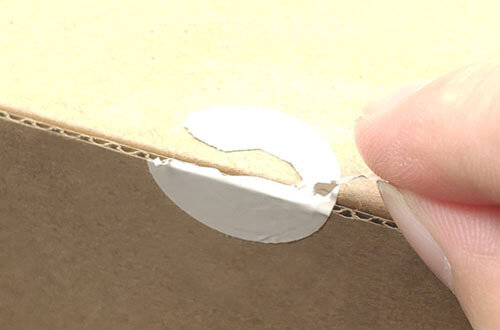
Fragile tags are made with special paper and glue that prevents the tag from being peeled off. The tag antenna is designed to remove the PET layer, which is used to make the tag fragile. After the tag is stuck to an item, the antenna will break automatically. This helps to prevent people from making fake versions of the item. Fragile tags are often used to keep track of valuable items, tobacco, and famous wines.
Anti metal RFID Stickers
An RFID anti-metal sticker is a sticker that can work on metal surfaces. It has an anti-metal material added to the original RFID sticker. Anti-metal labels can work on metal surfaces or on objects that contain water.

RFID Stickers By Frequency

125KHz RFID Sticker
A 125 kHz RFID sticker can be used for personal identification and helps protect information and data related to personal information. It is usually used in warehouses or wherever asset tracking is required.

13.56MHz RFID Stickers
13.56 MHz RFID stickers are mainly used for anti-counterfeiting and NFC applications, such as tracking high-end goods.

UHF RFID Stickers
RFID UHF RFID S can be customized with logos, serial codes, or EPC lasers. It can be used for asset management, unmanned retail, etc.
How to Choose the Right RFID Stickers
1. Make sure you have your own system
RFID stickers can’t be used on their own. You need to have your own system or be a system integrator so you can buy your own RFID tags.
2. Tell us the type of chip you are using
The chip is the most important part of the RFID system. It stores and exchanges data. The first step in designing the system is choosing a good chip model. Different chip models have different features and prices. You need to determine which model is right for your system.
If you don’t know your chip model, you can send us a sample of your hand to help us test the model.
3. Select RFID Stickers material and size
The price depends on the material and size. Choose the material and size that works best for your budget.
4. Define your additional processes
We can customize the logo, print UID, encoding data, etc. for RFID stickers.
Getting Your RFID Stickers
Our professional technical team is here to help. We invite you to compare our prices and services.
- All information is kept secret and safe.
Application of RFID Stickers
RFID stickers can be attached to any surface. To expose the adhesive layer of the tag, remove the cover. Here are some of the major applications of RFID stickers:
Vehicle Identification
RFID stickers are used for the most important purpose. The sticker has enough memory to store details such as the purchase date, vehicle ID, last serviced date, and date of purchase, as well as other important details. When your vehicle comes near an RFID reader, it will show this information to make it easy to identify your vehicle.
This information is particularly important in the following sectors:
- Car Wash Facilities: Most car wash facilities have an RFID reader. The service providers give their customers RFID stickers that must be attached on the vehicle. This enables cleaners to read about the condition of the car and the owner’s preferences before cleaning. Some of the details that can be saved in such stickers include the last visit day, the owner’s preference on level/type of cleaning, and frequency of cleaning.
- Tolling stations: RFID stickers can be used to pay tolls, flag overweight vehicles, and identify defaulters. Toll stations have RFID readers that capture details about every car fitted with an RFID sticker. The tag can also be linked to bank details to automatically pay toll fees.
- Car dealerships: When dealing with many vehicles, it is difficult to memorize the specifications for each car. RFID stickers can help. Each car can have its details written on an RFID sticker and attached to the car. Then, the details of the car can be easily retrieved by scanning the RFID sticker.
Asset Tracking
RFID stickers are great for tracking assets. They stick really well and last a long time. Scan the tags to quickly find asset information.
Estimating Delivery Times
Long-distance trucks deliver goods to specific buyers. Since these deliveries are often very important, buyers and sellers want to know exactly where the trucks are and when they will arrive.
One of the best tracking technologies is RFID. RFID stickers are small tags that can be read by RFID readers. These readers are often found at tolls. When the trucks pass through a toll with an RFID reader, the time is recorded. This helps the drivers know where the trucks are and how long it will take to deliver.
Inventory Management
RFID stickers are a cheap way to identify and manage products. You can stick them on each of your products, which allows for easy checkout and tracking of orders.
To do this, you will need an RFID reader. When you flash any object past the reader, it will show the item’s tracking details like the purchase date, number of items in stock, batch number, and expiration date.
This system helps you avoid running out of stock or having excess inventory. It also helps you identify items that are about to expire, so you can easily dispose of them.
Track Visitors’ Entry and Exit
Some countries, such as Japan and Norway, have included an RFID tag on passports. RFID tags are small chips that can store information about visitors. This information is important because it helps to monitor who enters or leaves a country, which improves security.
RFID stickers are particularly useful because they are thin and can be made using a transparent material. This makes it easy for them to be attached to the passport without affecting its readability or functionality.
Frequent Asked Questions
What is RFID label sticker?
RFID stickers and labels are often used to mark inventory or expensive assets so that they can be tracked using RFID. Each label contains an RFID chip and antenna, which can be printed or pre-printed and can be quickly pasted to improve work efficiency.
How do RFID stickers work?
The RFID sticker and RFID tag work the same way. The RFID reader antenna supplies the tag with power through radio waves to make it interact with data.
What is the range of rfid sticker?
The reading range of high-frequency and low-frequency RFID stickers is usually 0-10 centimeters. Using high-power readers can reach 1-2 meters. UHF RFID sticker tags can read up to 12 meters, but UHF tags are most susceptible to interference.
Can I print my own RFID tags?
RFID stickers can be printed. You can have your print material customized with the corresponding RFID stickers. You can also have our factory print them for you.
What is the cost of RFID stickers?
The main benefit of passive RFID systems is that tags are very cheap. They cost between $0.10 and $1.50 each. These tags also don’t need batteries, so they last for many years.
Common RFID chips
| IC | Memory | Protocol | Read/Write | Datasheet |
|---|---|---|---|---|
| TK4100 | 64bit | ISO7815 | Read-only | Download |
| EM4200 | 128bit | ISO7815 | Read-only | Download |
| EM4305 | 512bit | ISO11784/11785 | Read&Write | Download |
| EM4450 | 1kbit | ISO11784/11785 | Read&Write | Download |
| ATA5577 | 224bit | ISO11784/11785 | Read&Write | Download |
| Hitag 1 | 2048bit | ISO11784/11785 | Read&Write | Download |
| Hitag2 | 256bit | ISO11784/11785 | Read&Write | Download |
| MIFARE Classic 1k(S50) | 1K Bytes | ISO14443A | Read&Write | Download |
| MIFARE Classic 4k(S70) | 4K Bytes | ISO14443A | Read&Write | Download |
| MIFARE Ultralight EV 1 | 512bit | ISO14443A | Read&Write | Download |
| MIFARE Ultralight C | 192 Bytes | ISO14443A | Read&Write | Download |
| MIFARE Plus EV2(2K) | 2K Byte | ISO14443A | Read&Write | Download |
| MIFARE Plus EV2(4K) | 4K Bytes | ISO14443A | Read&Write | Download |
| MIFARE Plus SE(2K) | 2K Byte | ISO14443A | Read&Write | Download |
| MIFARE Plus SE(4K) | 4K Byte | ISO14443A | Read&Write | Download |
| MIFARE Plus X(2K) | 2K Byte | ISO14443A | Read&Write | Download |
| MIFARE Plus X(4K) | 4K Byte | ISO14443A | Read&Write | Download |
| MIFARE Desfire Light | 640 Bytes | ISO14443A | Read&Write | Download |
| MIFARE Desfire EV3(2K) | 2K Bytes | ISO14443A | Read&Write | Download |
| MIFARE Desfire EV3(4K) | 4K Bytes | ISO14443A | Read&Write | Download |
| MIFARE Desfire EV3(8K) | 8K Bytes | ISO14443A | Read&Write | Download |
| NTAG 213 | 144 Bytes | ISO14443A | Read&Write | Download |
| NTAG 215 | 504 Bytes | ISO14443A | Read&Write | Download |
| NTAG 216 | 888 Bytes | ISO14443A | Read&Write | Download |
| NTAG 213 Tag Temper | 144 Bytes | ISO14443A | Read&Write | Download |
| NTAG 424 DNA | 416 Bytes | ISO14443A | Read&Write | Download |
| NTAG 424 DNA Tag Tamper | 416 Bytes | ISO14443A | Read&Write | Download |
| ICODE SLIX | 896 bits | ISO15693/ISO 18000-3M1 | Read&Write | Download |
| ICODE SLIX 2 | 2528 bits | ISO15693/ISO 18000-3M1 | Read&Write | Download |
| ICODE SLIX-L | 256 bits | ISO15693/ISO 18000-3M1 | Read&Write | Download |
| ICODE SLIX-S | 1280 bits | ISO15693/ISO 18000-3M1 | Read&Write | Download |
| ICODE DNA | 2016 bits | ISO15693/ISO 18000-3M1 | Read&Write | Download |
| Tag-It™ HF-I Standard (TI 256) | 256 Byte | ISO15693 | Read&Write | Download |
| Tag-It™ HF-I Plus (TI 2048) | 2K Bytes | ISO15693 | Read&Write | Download |
| Higgs 3 | 96 bit epc,512 bit user | EPC Class1 Gen2/ISO 18000 6C | Read&Write | Download |
| Higgs 4 | 128 bit epc,512 bit user | EPC Class1 Gen2/ISO 18000 6C | Read&Write | Download |
| MONZA 4QT | 128 bit epc,512 bit user | EPC Class1 Gen2/ISO 18000 6C | Read&Write | Download |
| Monza 5 | 128 bit epc,32 bit user | EPC Class1 Gen2/ISO 18000 6C | Read&Write | Download |
| Monza R6 | 96bit epc | EPC Class1 Gen2/ISO 18000 6C | Read&Write | Download |
| Monza R6-P | 96bit epc,32 bit user | EPC Class1 Gen2/ISO 18000 6C | Read&Write | Download |
| UCODE 7 | 128 bit epc | EPC Class1 Gen2/ISO 18000 6C | Read&Write | Download |
| UCODE 7m | 128 bit epc | EPC Class1 Gen2/ISO 18000 6C | Read&Write | Download |
| Ucode 8 | 128 bit epc | EPC Class1 Gen2/ISO 18000 6C | Read&Write | Download |
| Ucode 8m | 96 bit epc,32 bit user | EPC Class1 Gen2/ISO 18000 6C | Read&Write | Download |
| UCODE DNA | 224bit epc,3072 bit user | EPC Class1 Gen2/ISO 18000 6C | Read&Write | Download |